Study & Discussion Guide
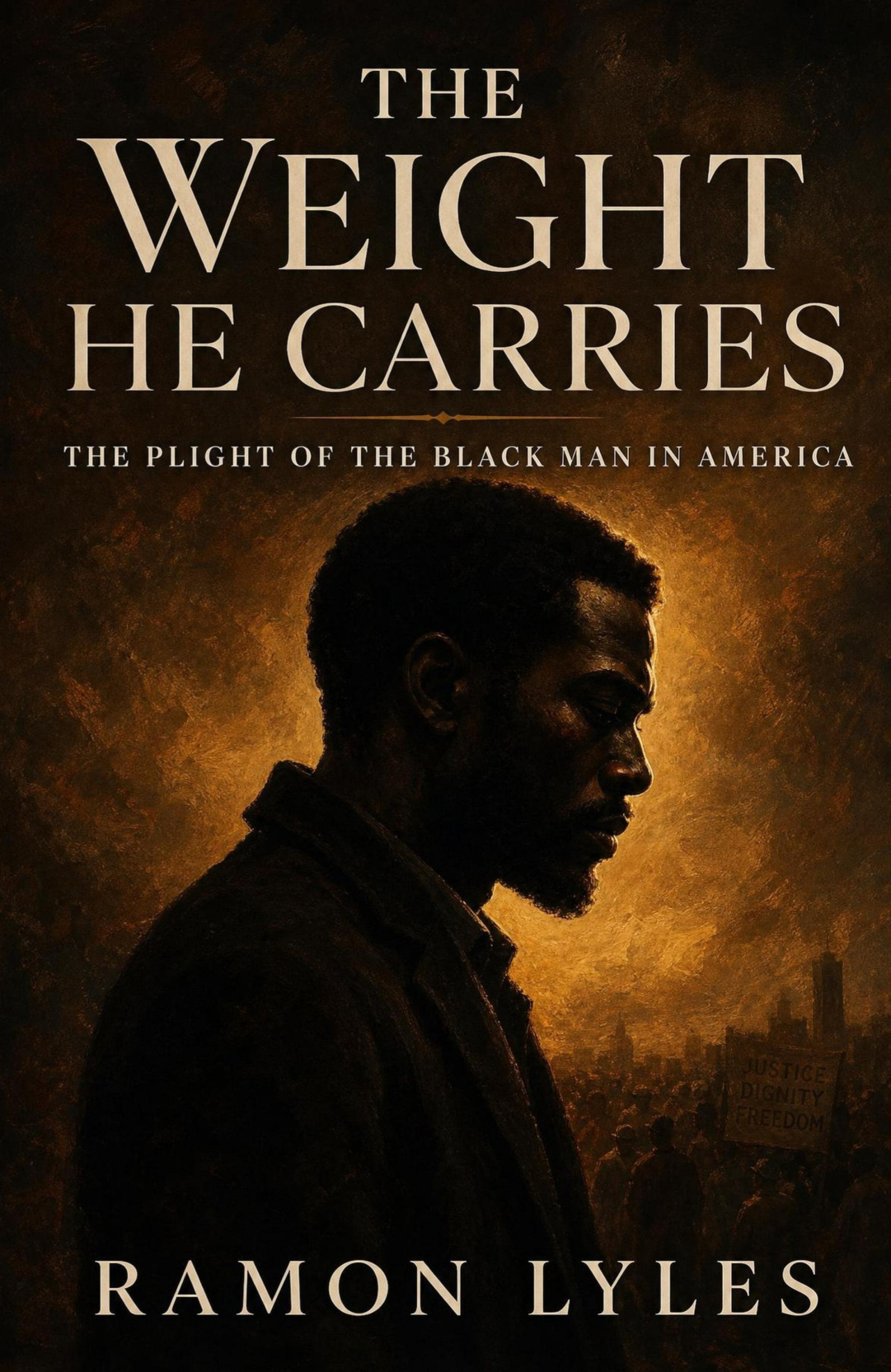
Front cover of The Weight He Carries by Ramon Lyles

The Weight He Carries

A Study and Discussion Guide

This guide is built for three kinds of readers: a group that meets and talks, a person reading alone with a pen, and a leader who has to hold the room while hard things get said. Every part of the book gets an overview, chapter by chapter discussion questions, a private journal prompt, and a note for whoever is facilitating. Nothing here asks a reader to agree with the book. It asks a reader to stay in the conversation long enough to be honest.

How to use this guide

  • Read the part first, then come to the questions. The questions assume the reading is done and will feel thin without it.
  • Group sections are meant to be spoken out loud. Pick three or four questions per meeting, not all of them. A good group finishes fewer questions than it planned.
  • Solo sections are meant to be written, not discussed. Give them a notebook, ten minutes, and no audience.
  • Leader notes name where the room is likely to get tight, and what to do when it does.
  • Scripture and care notes appear where the book touches faith, grief, or trauma. Skip them if they do not fit the setting.
  • There is no requirement to move in order. If one part is closer to home, start there.

Group covenant

Read this out loud before the first session. Agree to it before anyone answers a question.

  • What is said in the room stays in the room.
  • Speak from your own life. No speaking for a whole group of people.
  • Disagree with the idea, not the person holding it.
  • Silence is allowed. Nobody has to perform a feeling to prove they had one.
  • Anyone can pass on any question, with no explanation owed.
  • One conversation at a time. No side talk while someone is being vulnerable.

Six week reading plan

WeekReadingFocus
Week 1Introduction, How to Read This Book, Chapters 1 to 3Set the covenant. Establish that history here is evidence, not opinion.
Week 2Chapters 4 and 5Place and schooling. Map your own neighborhood and classroom.
Week 3Chapters 6 to 8The machinery: cell, clinic, church. Have care resources printed.
Week 4Chapters 9 to 12, Interlude, A Kitchen in OctoberFathers, sons, silence. The heaviest week. Protect the pauses.
Week 5Chapters 22 to 28, Interlude, A Woman at the WindowWhat she carried. Women speak first on every question.
Week 6Chapters 13 to 21, EpilogueWhat survived. Close with one sentence per person.
Part I

The Inheritance

Before he chose a friend, a job, or a woman, the country had already decided a great deal about him. Part I traces what was in his hands before his hands were his own: the manufacture of distrust, the ledger of debts nobody signed for, and the wage paid in something other than money.

Names, dates, and situations to remember

Keep this open while you read. These are the people, years, and events this part of the book is built on.

People
Anthony JohnsonCh. 1
Free Black Virginia landowner who ended up holding John Casor for life, an early crack in any idea of natural solidarity.
Nathaniel Bacon and Governor William BerkeleyCh. 1
The rebellion and its suppression that pushed colonial leaders to split poor whites from enslaved Africans by law.
Thomas JeffersonCh. 1
Monticello enslaver who separated skilled nailery labor from field labor, ranking people inside bondage.
William O'NealCh. 1
FBI informant inside the Black Panther Party, tied to the killing of Fred Hampton in 1969.
General William T. Sherman and President Andrew JohnsonCh. 2
One issued Special Field Order No. 15, the other revoked it. The forty acres that never landed.
Frederick DouglassCh. 2, 5
Voice on the broken promises of Reconstruction, and on how literacy was the thing most feared.
Ida B. WellsCh. 2
Documented that lynching often followed Black economic success, not crime.
Green CottenhamCh. 3
Convict leased to a U.S. Steel subsidiary and dead by 1908, the human face of slavery by another name.
W. E. B. Du BoisCh. 3
Named the psychological wage of whiteness, the payment made in status rather than money.
Ossian SweetCh. 4
Black surgeon tried in 1925 Detroit after defending his new home from a white mob.
Maggie Lena WalkerCh. 4
Chartered St. Luke Penny Savings Bank in 1903, the first Black woman bank president.
Ruby Bridges and Barbara HenryCh. 5
A six year old and the one teacher who would stand in the room with her.
Julius Rosenwald and Booker T. WashingtonCh. 5
The partnership that built thousands of schools the states would not build.
Dates
1662Ch. 1
Virginia writes partus sequitur ventrem: a child's status follows the mother. Slavery becomes hereditary.
1676Ch. 1
Bacon's Rebellion, poor whites and Black laborers together, and the legal wedge that follows.
1691, 1705, 1712Ch. 1
Marriage bans, the Slave Codes, and patrol laws that turned custom into statute.
1865Ch. 2
Emancipation, Special Field Order No. 15, and the founding of the Freedmen's Bureau.
1872 and 1874Ch. 2
The Bureau is shut down; the Freedman's Savings Bank collapses with Black deposits inside it.
1892Ch. 2
People's Grocery lynchings in Memphis, the case that turned Ida B. Wells into an investigator.
1921 and 1923Ch. 2
Greenwood in Tulsa burns; Rosewood, Florida is destroyed. Compensation for Rosewood comes in 1994.
1935 and 1938Ch. 3
Social Security and the Fair Labor Standards Act exclude farm and domestic work, the two fields most Black workers held.
1944Ch. 2, 3
The G.I. Bill is signed, then administered locally so that Black veterans are largely written out of it.
1934 to 1968Ch. 4
The federal redlining era. HOLC maps grade Black neighborhoods hazardous and lenders follow the color.
1968Ch. 4
The Fair Housing Act passes one week after Dr. King is killed.
1954Ch. 5
Brown v. Board, followed by closures, Massive Resistance, and Prince Edward County.
Situations
The manufacture of distrustCh. 1
Division between poor people is written into colonial law after 1676, on purpose and in writing.
Forty acres, reversedCh. 2
Land granted in 1865 and taken back within a year, sending freedpeople into sharecropping and debt.
Tulsa and RosewoodCh. 2
Two self built Black communities destroyed by mobs, and what the destruction cost across generations.
Convict leasingCh. 3
Arrest as labor policy after 1865, with Green Cottenham's death as the record of it.
The redlining mapsCh. 4
1935 to 1940 HOLC grading that decided which families could build equity for the next eighty years.
Urban renewal and the highwaysCh. 4
Overtown, Black Bottom, and Rondo cleared for interstates. What Baldwin called Negro removal.
Criminalized literacyCh. 5
The 1740 South Carolina Negro Act and post Nat Turner bans, and the schools built anyway.
The resume auditCh. 3
The Bertrand and Mullainathan study: identical resumes, different names, different callbacks.

Chapter 1: Where the Distrust Was Planted

The Virginia record and the long, deliberate manufacture of division. Distrust between people is presented not as a natural instinct but as a policy outcome.

For the group
  1. The chapter argues that division was built, not born. What in the record convinced you, and what did you want more proof of?
  2. Where do you see the same tactic, poor people set against each other, operating today?
  3. What were you taught about the origins of race in this country, and who taught it to you?
On your own

Write the first moment you remember understanding that people were sorted by color. How old were you, and who was in the room?

Chapter 2: The Ledger

An accounting of what was taken and what was never returned, and what it means to inherit a balance you did not run up.

For the group
  1. What does it change, if anything, to see history presented as a balance sheet rather than a story?
  2. Which entry in the ledger was new to you?
  3. Who benefits from the ledger staying closed?
On your own

List what you inherited that you did not earn, good and bad. Do not soften either column.

Chapter 3: The Wage

The idea that status can be paid out instead of money, and what it costs everyone who accepts it.

For the group
  1. Where have you seen people accept status in place of actual gain?
  2. How does the wage described here keep working when the people paying it are gone?
  3. What would it take for someone to refuse it?
On your own

Name a time you were offered a small advantage that kept you quiet about a larger wrong.

Chapter 4: The Neighborhood

Housing, lines drawn on maps, and how an address becomes a forecast for a life.

For the group
  1. What did the map of your childhood look like, and who lived on which side of it?
  2. How much of what you have was built on where your family was allowed to buy?
  3. What would repair look like at the level of a single street?
On your own

Trace the address history of your family for three generations. What does the map tell you?

Chapter 5: The Schoolhouse

Who gets taught, what gets taught, and how expectation becomes outcome inside a classroom.

For the group
  1. Was there a teacher who decided what you were capable of before you finished a sentence? What did that do?
  2. The book describes reading as freedom. Where have you seen access to literacy protected or withheld?
  3. What does an honest curriculum owe a child?
On your own

Write a letter to the teacher who got you wrong, or the one who got you right. Do not send it yet.

Leader note

Part I tends to split a room between people who already knew this history and people encountering it for the first time. Do not let the second group be shamed into silence, and do not make the first group into the teaching staff. Say at the top: nobody is here to explain their whole people. If the conversation turns into a debate about whether the history is real, redirect to what the reader felt while reading rather than what they can prove.

Part II

The Machinery

The inheritance did not stay in the archive. It was rebuilt into schools and banks, into blocks and clinics, into cells and precincts. Part II walks through the machinery of what a country does with a people it has already decided about, and includes the Interlude, A Kitchen in October.

Names, dates, and situations to remember

Keep this open while you read. These are the people, years, and events this part of the book is built on.

People
George JacksonCh. 6
Killed at San Quentin in August 1971, weeks before Attica.
Nelson RockefellerCh. 6
Ordered the retaking of Attica in September 1971.
John EhrlichmanCh. 6
Nixon aide who later admitted the drug war was aimed at specific communities.
J. Marion SimsCh. 7
Operated on enslaved women, including Anarcha, without anesthesia, and was called a father of gynecology.
Henrietta LacksCh. 7
Her cells were taken at Johns Hopkins in 1951 and used worldwide; a settlement came only in 2023.
Mona Hanna-AttishaCh. 7
The pediatrician whose data forced Flint's water crisis into the open.
Charles DrewCh. 7
Pioneer of blood banking who resigned from the Red Cross in 1942 over segregated blood.
Kizzmekia CorbettCh. 7
NIH virologist whose spike protein work underlies the Moderna vaccine.
Daniel Patrick MoynihanCh. 9
Author of the 1965 report that made the Black family the explanation for everything done to it.
Marion Stubbs Thomas and Mary McLeod BethuneCh. 9
Founders of Jack and Jill (1938) and the National Council of Negro Women (1935).
Kool Herc and Berry Gordy Jr.Ch. 10
The Bronx block party of 1973 and Motown in 1959, two inventions of a whole sound.
Emmett TillCh. 11
The murder that became the lesson Black boys were taught about their own bodies.
William SmithCh. 11
Coined racial battle fatigue, the medical name for the daily cost.
Dates
December 1865Ch. 6
The Thirteenth Amendment abolishes slavery except as punishment for crime. The exception becomes the industry.
1928Ch. 6
Alabama, the last state, finally ends convict leasing.
August and September 1971Ch. 6
George Jackson is killed at San Quentin; the Attica uprising runs September 9 to 13.
1994Ch. 6
The Violent Crime Control and Law Enforcement Act, the Crime Bill, and the sentencing decades that follow.
1845 to 1849Ch. 7
Sims's experimental surgeries on Anarcha, Betsey, and Lucy.
1932 to 1972Ch. 7
The Tuskegee syphilis study runs for forty years, twenty-five of them after penicillin.
1951Ch. 7
Henrietta Lacks's cells are taken without consent.
2014 and 2022Ch. 7
Flint's water crisis begins; Jackson, Mississippi loses its water system.
1965Ch. 9
The Moynihan Report is published and becomes policy language for a generation.
Summer 1973Ch. 10
Kool Herc's block party, the night hip hop starts.
1955Ch. 11
Emmett Till is murdered, and the silence taught afterward becomes inheritance.
2007 to 2020Ch. 11
Suicide among Black youth rises roughly sixty percent.
Situations
The punishment clauseCh. 6
One phrase in the Thirteenth Amendment that let Black Codes, convict leasing, and mass incarceration follow abolition.
AtticaCh. 6
An uprising over conditions, and a retaking that answered it with gunfire.
The 1994 Crime BillCh. 6
Bipartisan support, longer sentences, and the prison population that resulted.
Medicine without consentCh. 7
Sims, Tuskegee, and Henrietta Lacks as the reason distrust of doctors is memory, not superstition.
Flint and JacksonCh. 7
Two water systems allowed to fail in majority Black cities.
The Moynihan ReportCh. 9
A federal document that diagnosed the family instead of the policy, against CDC data on Black fathers.
Hip hop's turnCh. 10
From street journalism to an industry that paid best for the most dangerous version of the story.
The taught silenceCh. 11
How grief becomes anger becomes blood pressure, and what a kitchen in October costs to break.

Chapter 6: The Cell

The choreography families learn before children can name it, and a system that filled faster than any crime wave explains.

For the group
  1. The chapter calls the family's response choreography, a muscle memory. What version of that was taught in your home?
  2. What does it do to a nine-year-old to already know the steps?
  3. Where is the line between safety instructions and inherited fear?
On your own

Write down the instructions you were given about police. Then write what you would give a child today.

Chapter 7: The Doctor

A grandmother dead at sixty-eight, and the difference between dying of old age and dying of a lifetime.

For the group
  1. Whose death in your family looked normal until you did the math?
  2. What keeps people from care: distance, cost, time, or the memory of not being believed?
  3. What would you want a physician to read from this chapter?
On your own

Write the health history of the person who raised you. Mark what was preventable.

Chapter 8: The Church

Faith as shelter and faith as cover, held in the same hand.

For the group
  1. Where has the church in your experience carried weight, and where has it added to it?
  2. How do you love an institution that has hurt people you love?
  3. What would justice, mercy, and faithfulness look like on a Sunday morning?
On your own

Write what you still believe, and what you stopped believing, and when the change happened.

Chapter 9: Fathers

Four generations in one frame, against a national story that had already declared the family broken.

For the group
  1. Whose version of the Black family did you grow up hearing, and who was telling it?
  2. What does the photograph in this chapter argue that statistics cannot?
  3. Where does the difference between absent and unseen matter most?
On your own

Describe a photograph from your family that tells the truth better than any story about it.

Chapter 10: Sons

Music as the community's oldest way of talking to itself, and what happens when pieces of the soul go up for sale.

For the group
  1. What song carried the news in your house?
  2. Where is the line between telling the truth about a life and selling a caricature of it?
  3. What is being handed to boys through what they listen to right now?
On your own

Pick one song from your adolescence. Write what it taught you about being a man.

Chapter 11: The Silence

A son at twenty-seven watching his father cry for the first time, and everything nobody taught either of them.

For the group
  1. Who taught you what a man does with grief?
  2. What did the silence in your house protect, and what did it cost?
  3. When was the last time you let someone see you break?
On your own

Write the thing you have never said out loud. Nobody reads this but you.

Chapter 12: Love and Grief

A wedding photograph where one person looks at the camera and the other looks at his bride.

For the group
  1. What did you learn about love from watching the couple who raised you?
  2. Why is being seen harder to give than being provided for?
  3. What does long love require that young love does not know yet?
On your own

Write about the person who looks at you the way the groom looks in that photo, or the absence of one.

You have neglected the more important matters of the law: justice, mercy and faithfulness.
Matthew 23:23

For faith settings, pair this with Chapter 8. Ask what the congregation tithes attention to, and what it neglects.

Leader note

This is the heaviest stretch of the book for men in the room. Chapters 11 and 12 open old doors. Watch for the man who cracks a joke immediately after a serious answer, that is usually the person closest to the surface. Let the room sit in a pause instead of rescuing it. Have a name and number for local counseling written on the handout before the session starts, not offered as an afterthought at the end.

Part III

What She Carried

A book about the weight the Black man carries is not honest until it sits with the weight the Black woman carries beside him, and often for him. Part III is hers, and includes the Interlude, A Woman at the Window.

Names, dates, and situations to remember

Keep this open while you read. These are the people, years, and events this part of the book is built on.

People
Harriet TubmanCh. 22
Not only a conductor: a military strategist who led the Combahee Ferry Raid in 1863.
Sojourner TruthCh. 22
Her 1851 Ohio speech, and the dialect later put into her mouth by someone else.
Ella Baker and Diane NashCh. 22
Founded SNCC in 1960 and organized the Freedom Rides in 1961 while men got the microphones.
Fannie Lou HamerCh. 22, 24
Sterilized without consent in 1961, testified before the 1964 Democratic convention anyway.
Kimberle CrenshawCh. 22
Named intersectionality in 1989, the framework for how two weights land at once.
Breonna Taylor, Sandra Bland, Rekia BoydCh. 22
The names behind Say Her Name.
Sarah BaartmanCh. 23
Displayed in London and Paris from 1810, dissected after her death, returned to South Africa in 2002.
Recy TaylorCh. 23
Raped in Abbeville, Alabama in 1944; Rosa Parks was sent to investigate.
Megan Thee StallionCh. 23
Shot in 2020, disbelieved publicly, with a conviction only in 2022.
Kira Johnson and Shalon IrvingCh. 24
Two women with every advantage who still died of postpartum complications.
Minnie and Mary Alice RelfCh. 24
Sterilized as children in Alabama in 1973 on a signature their mother could not read.
Anthony SowellCh. 25
Cleveland killer whose victims were dismissed as missing women nobody looked for.
Derrica and Natalie WilsonCh. 25
Founded the Black and Missing Foundation in 2008 to do what the coverage would not.
Ossie Davis and Ruby DeeCh. 27, 28
Fifty-six years of marriage as public evidence against the wedge.
Mildred and Richard LovingCh. 28
Arrested in 1958, vindicated by Loving v. Virginia in 1967.
Dates
1810 to 1815Ch. 23
Sarah Baartman exhibited, then dissected by Georges Cuvier. Her remains go home in 2002.
1944Ch. 23
The Recy Taylor case, and the investigation Rosa Parks conducted long before a bus.
1961Ch. 24
Fannie Lou Hamer's Mississippi appendectomy, a hysterectomy she did not agree to.
1929 to 1974Ch. 24
The North Carolina Eugenics Board sterilizes roughly 7,600 people.
1973Ch. 24
The Relf sisters, ages twelve and fourteen, are sterilized.
2006 to 2010Ch. 24
Sterilizations inside California prisons, decades after anyone claimed the practice ended.
2007 to 2009Ch. 25
The Sowell murders in Cleveland, and the reports that were never worked.
1977Ch. 22, 27
The Combahee River Collective Statement.
1989Ch. 22
Crenshaw publishes the intersectionality paper.
1967Ch. 28
Loving v. Virginia. Marriage across the color line becomes legal nationwide.
Situations
The flattening of Black women organizersCh. 22
Tubman, Truth, Baker, and Hamer reduced to slogans while the strategy was theirs.
Baartman's body as exhibitCh. 23
A living woman turned display, then specimen, then finally a burial.
The pattern of disbeliefCh. 23
Recy Taylor to Megan Thee Stallion: the survivor is cross examined before the accused is.
Forced sterilizationCh. 24
Hamer, the Relf sisters, North Carolina, and California prisons. Consent that was never asked for.
Black maternal mortalityCh. 24
Roughly two and a half to three times the white rate, education and income included.
Missing and uncoveredCh. 25
Who gets a press conference and who gets a file, from the Sowell case forward.
The wedge between themCh. 26, 27
Auction block, convict leasing, incarceration, and a federal report, all pushing a man and a woman apart.
Love as resistanceCh. 28
Broom weddings, Freedmen's Bureau marriage lines, and marriages that lasted fifty years anyway.

Chapter 22: The Woman Who Held the Roof Up

What it costs to be the one everyone leans on, and what it costs to never be asked if your back hurts.

For the group
  1. Who held the roof up in your family, and what did it take out of her?
  2. How does praise for strength function as a way of avoiding help?
  3. What would it look like to relieve her instead of admire her?
On your own

Write what you owe her, plainly, without a compliment in it.

Chapter 23: Sarah Baartman to Megan Thee Stallion

Two centuries between a cage off Piccadilly and a courtroom, and the line running straight between them.

For the group
  1. What does the book mean when it says nobody in the room asked her name?
  2. Where do you see the same display and disbelief operating now?
  3. Who is allowed to be believed when she says she was hurt?
On your own

Write about a time you watched a woman get doubted and said nothing.

Chapter 24: The Delivery Room

Where pain gets measured differently depending on the patient, and what that costs mothers and children.

For the group
  1. What did you know about maternal outcomes before this chapter?
  2. What should a partner do in a room where his wife is not being believed?
  3. What changes if the hospital, not the mother, is asked to explain the number?
On your own

Write down three questions you would ask at the next appointment you attend with someone you love.

Chapter 25: The Missing Girls

Which disappearances become national news and which never get a headline.

For the group
  1. Whose face gets the camera, and who decides?
  2. What does a community do when the coverage does not come?
  3. What would you want done if she were yours?
On your own

Search a name of a missing girl from your own state. Write what you find and what you do not.

Chapter 26: When He Was Gone

The household that keeps running after a man is removed, by prison, by work, by death, or by choice.

For the group
  1. What happens to a home in the first month after he is gone?
  2. How do children explain the absence to themselves when nobody explains it to them?
  3. Where does the community step in, and where does it look away?
On your own

Write about an absence in your own house and the person who covered it.

Chapter 27: The Wedge Between Us

How Black men and Black women got taught to argue with each other instead of with what was done to both.

For the group
  1. What arguments between Black men and women does the culture reward with attention?
  2. Where have you participated in the wedge without meaning to?
  3. What would a conversation look like that refused it?
On your own

Write one thing you have said about the other, publicly or privately, that you would take back.

Chapter 28: The Love That Survived Anyway

After everything Part III names, what still gets built between them.

For the group
  1. What in this chapter surprised you after the six before it?
  2. What does love look like when it has to survive a system, not just a season?
  3. Who is the couple you point to, and what do they do that you do not?
On your own

Write the terms of the love you want, in specifics, not adjectives.

Leader note

In mixed groups, this part goes wrong in one predictable way: men begin defending themselves before women finish speaking. Set a rule at the top of the session, women speak first on every question in Part III, and men respond only after. If the group is all men, do not let the discussion become a performance of guilt. The goal is not for men to feel bad. The goal is for men to be able to describe accurately what the women around them carry.

Part IV

What Survived

Everything the previous parts describe was aimed at ending what these chapters are about. It did not end. Part IV is the part of the inheritance nobody engineered and nobody could kill, along with the reckoning chapters that carry the book to the epilogue.

Names, dates, and situations to remember

Keep this open while you read. These are the people, years, and events this part of the book is built on.

People
Hiram RevelsCh. 13
Seated in 1870 as the first Black United States senator, in a window that closed fast.
Fannie Lou Hamer, Medgar Evers, Vernon Dahmer, Herbert LeeCh. 13
People who paid with their lives for the paperwork of registration.
Chaney, Goodman, and SchwernerCh. 13
Three organizers murdered in Mississippi during the voter drives.
John LewisCh. 13
Selma in 1965, and a lifetime spent guarding what was won there.
Shirley ChisholmCh. 13
Elected to Congress in 1968, ran for president in 1972.
Stacey AbramsCh. 13
Modern organizing against the machinery of removal from the rolls.
A. G. Gaston and Reginald LewisCh. 14
Two men who built real capital and left instructions for how.
Mamie TillCh. 18
Insisted on an open casket in 1955 so the country would have to look.
Darnella FrazierCh. 18
Seventeen years old, held the phone steady in 2020.
George Stinney Jr.Ch. 19
Executed at fourteen in South Carolina in 1944, exonerated in 2014.
John DiIulioCh. 19
Coined superpredator in the mid 1990s, a word that sentenced children.
Thomas Dartmouth Rice and D. W. GriffithCh. 20
Jump Jim Crow in 1830, Birth of a Nation in 1915. The mirror built on purpose.
Crispus Attucks and Sergeant William CarneyCh. 21
The first man to fall in Boston, and the flag that never touched the ground at Fort Wagner.
Isaac WoodardCh. 21
Blinded by police in 1946 while still in uniform, hours out of service.
Muhammad Ali and Martin Luther King Jr.Ch. 21
Both broke with the war in 1967, and both paid for it.
Dates
1770 and 1863Ch. 21
Attucks at the Boston Massacre; the Massachusetts 54th at Fort Wagner.
1870 and 1877Ch. 13
The Fifteenth Amendment and Revels seated, then the Compromise that ends Reconstruction.
1919Ch. 21
Red Summer. Black veterans come home and are attacked in uniform.
1946 and 1948Ch. 21
Isaac Woodard is blinded; Executive Order 9981 desegregates the military.
1955Ch. 18, 19
Emmett Till, and the casket his mother left open.
1965 and 1968Ch. 13
The Voting Rights Act; a first ballot cast at last; Chisholm elected.
1967Ch. 21
Ali refuses induction; King gives Beyond Vietnam at Riverside Church on April 4.
1830, 1915, 1973Ch. 20
Minstrelsy, Birth of a Nation at the White House, and the blaxploitation years Bogle catalogued.
2013Ch. 13
Shelby County v. Holder removes preclearance and the closures begin within days.
2014 and 2020Ch. 18, 19
Ferguson and Tamir Rice; then George Floyd and a summer of video.
Situations
The machinery of the ballotCh. 13
Literacy tests, poll taxes, and violence, then 1965, then 2013 and the quieter methods.
The vocabulary gapCh. 14
Compound interest, deeds, wills, and insurance as inherited language, or not inherited at all.
Scar tissue passed downCh. 15
Discipline, secrecy, and coping habits that protected one generation and cost the next.
The burden of proofCh. 18
Why a Black man's death still needs an autopsy, a video, and a trial before it is believed.
AdultificationCh. 19
Georgetown research showing Black children read as older and less innocent, and the discipline gap that follows.
The mirror industryCh. 20
Minstrel stage to studio to record label, each selling the frightening version back to everyone.
Service without returnCh. 21
Every American war fought by men who came home to segregation, and sometimes to a beating.
What survived anywayCh. 15, 28, Epilogue
Mentors, marriages, churches, barbershops, and the deliberate choice to hand down something better.

Chapter 13: Rage and the Small Stubborn Joys

A man asked how many bubbles are in a bar of soap, who wore a suit to vote twenty years later.

For the group
  1. What is the difference between rage that corrodes and rage that builds?
  2. Why the suit? What was he saying, and to whom?
  3. What small stubborn joy has kept you upright?
On your own

List five joys nobody gave you permission to have.

Chapter 14: What We Built While Carrying It

Equity, ownership, and what gets built by people who learned the word late.

For the group
  1. When did you first hear the word equity used the way this chapter means it?
  2. What did your family build without the head start?
  3. What do you want to be holding in ten years, and who taught you it was possible?
On your own

Write your own ledger, the asset side. Include what is not financial.

Chapter 15: What to Teach the Young

Butter beans in a Maxwell House can, and the thrift that kept a people alive.

For the group
  1. What object from your grandparents' house carries a whole philosophy?
  2. What do you want to pass down, and what do you refuse to pass down?
  3. How do you teach caution without teaching fear?
On your own

Write the five things you will say to a young person the next chance you get.

Chapter 16: The Weight, Set Down and Picked Back Up

An inventory of the load, and the question of what a man does with it now.

For the group
  1. What part of the weight is yours to carry, and what part were you handed?
  2. What can actually be set down, and what cannot?
  3. Who helps you carry it, and have you told them?
On your own

Name one weight you are setting down this month, and the first step you will take.

Chapter 17: The Auction Block Is Still Warm

Henry Bibb, separation as policy rather than byproduct, and how far the record still reaches.

For the group
  1. What does it mean that separation was the point rather than the side effect?
  2. Where do you see family separation still operating by other means?
  3. What does the country owe the descendants of a man who never found his wife?
On your own

Write what you know about your family before 1900. Then write what you cannot find out.

Chapter 18: The Body as Evidence

A meditation on the men whose bodies became national arguments.

For the group
  1. What happens to a person when their death becomes a debate?
  2. What is owed to the families who become symbols?
  3. How do you watch the footage, or refuse to?
On your own

Write a name you have not been able to put down, and why that one.

Chapter 19: The Boy Who Was Never Allowed to Be a Boy

Two seconds in Cudell Park, and the childhood that was assessed away.

For the group
  1. What does adultification take from a child before anything happens to him?
  2. Where have you seen a Black boy handled as a grown threat?
  3. What does a community owe its boys in the meantime?
On your own

Write about the last time you were allowed to be foolish and forgiven.

Chapter 20: The Man in the Mirror the Country Sold Him

A nine-year-old practicing a face he saw on a screen, and the market that sold it to him.

For the group
  1. Whose face did you practice, and who profited from you practicing it?
  2. What is the difference between an image and a mirror?
  3. What would you put on the poster instead?
On your own

Describe the face you put on for the world, and the one underneath.

Chapter 21: The War the Country Sent Him To

Service, sacrifice, and what came home with men who were asked to defend what would not defend them.

For the group
  1. What did service promise, and what did it deliver?
  2. How does a veteran in your family talk about it, or not?
  3. What does the country owe the men it sent?
On your own

Write about a man in your family who served, and what he came home to.

Leader note

End on Part IV whenever possible, even if the group skipped around. This section is where a group finds something to do with what it has been carrying for six weeks. Close the final session with the Epilogue read aloud, then go around the room once and let each person say one sentence, not a speech, about what they are taking with them.

Closing the study

A study of this book is not finished when the last question is answered. It is finished when somebody in the room changes something.

Before you leave the final session, write one commitment on an index card: a conversation you will have, a person you will call, a thing you will stop saying, a weight you will set down. Sign it and hand it to the person next to you. Ask them to check on you in thirty days.

That is the whole point. The book names the weight. The room decides what to do with it.